

From Edit Suite to Mixing Stage: Trinnov Monitoring for Post and Broadcast
7 September 2026
Technical Articles
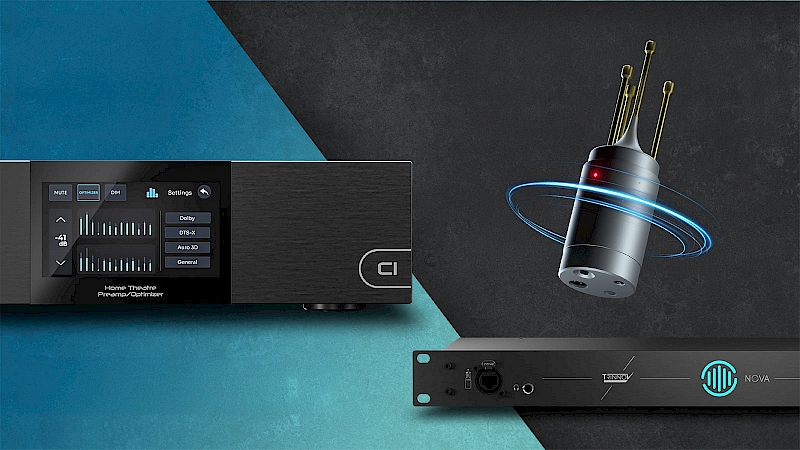
Immersive audio is no longer limited to the largest dubbing stages. It is now part of everyday workflows across film and television post-production, broadcast, music, streaming, and quality control. As formats and channel counts expand, one challenge remains constant: every creative and technical decision depends on the monitoring environment.
A monitoring system must do more than reproduce every channel. It must provide a reliable reference: one in which tonal balance, timing, spatial positioning, and low-frequency performance can be judged with confidence. In modern broadcast facilities, it must also integrate seamlessly into increasingly IP-based infrastructures, where standards such as SMPTE ST 2110-30 have become central to professional audio transport and interoperability.
Trinnov addresses these requirements at two complementary scales. NOVA brings monitor control and loudspeaker/room optimization to compact and mid-sized rooms, with support for immersive systems up to 7.1.4. AltitudeCI extends the same core approach to larger, higher-channel-count post-production, screening, and broadcast environments, while its SMPTE ST 2110-30 compatibility enables integration into modern IP-based broadcast workflows.
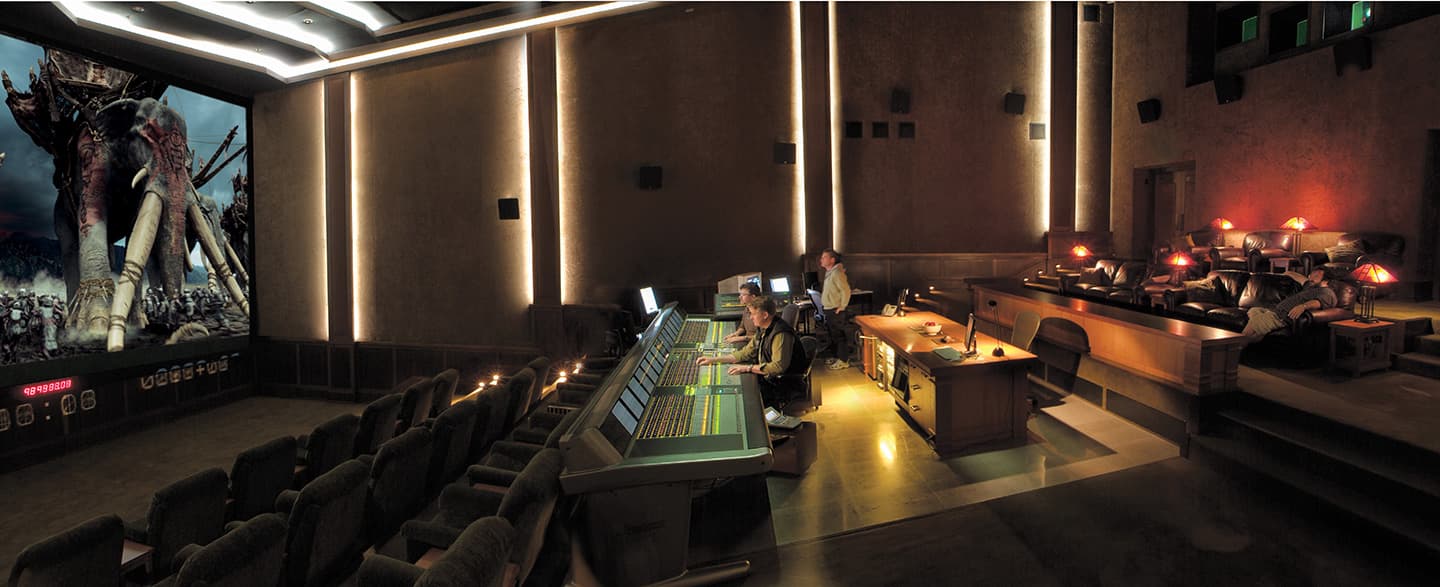
Park Road Post, Peter Jackson Facility in New-Zealand and Trinnov client since 2024
Monitoring Is Essential Part of the Production Chain
Acoustic treatment and careful loudspeaker placement remain essential, but no real room is perfectly neutral. Reflections, room modes, construction constraints, and small differences between loudspeakers can alter frequency response, phase, level, and arrival time. In an immersive room, these variables multiply across every speaker and subwoofer.
The result can be uncertainty: Is a tonal imbalance in the mix or in the room? Is an object moving incorrectly, or is one loudspeaker arriving late? Is the low end excessive, or is the listening position sitting in a room-mode peak?
Trinnov’s Optimizer measures the loudspeakers and their interaction with the room in three dimensions, then applies corrections to frequency, phase, level, and delay. The objective is not to replace acoustic design or impose a particular sound. It is to create a more accurate, predictable monitoring reference so that engineers can speed up decisions and trust those decisions beyond the room in which they were made.
That consistency is especially valuable in broadcast and post-production facilities, where the same project may move between editorial rooms, premix suites, finishing stages, and QC environments. When monitoring varies less from room to room, work translates more reliably, and fewer decisions need to be revisited.
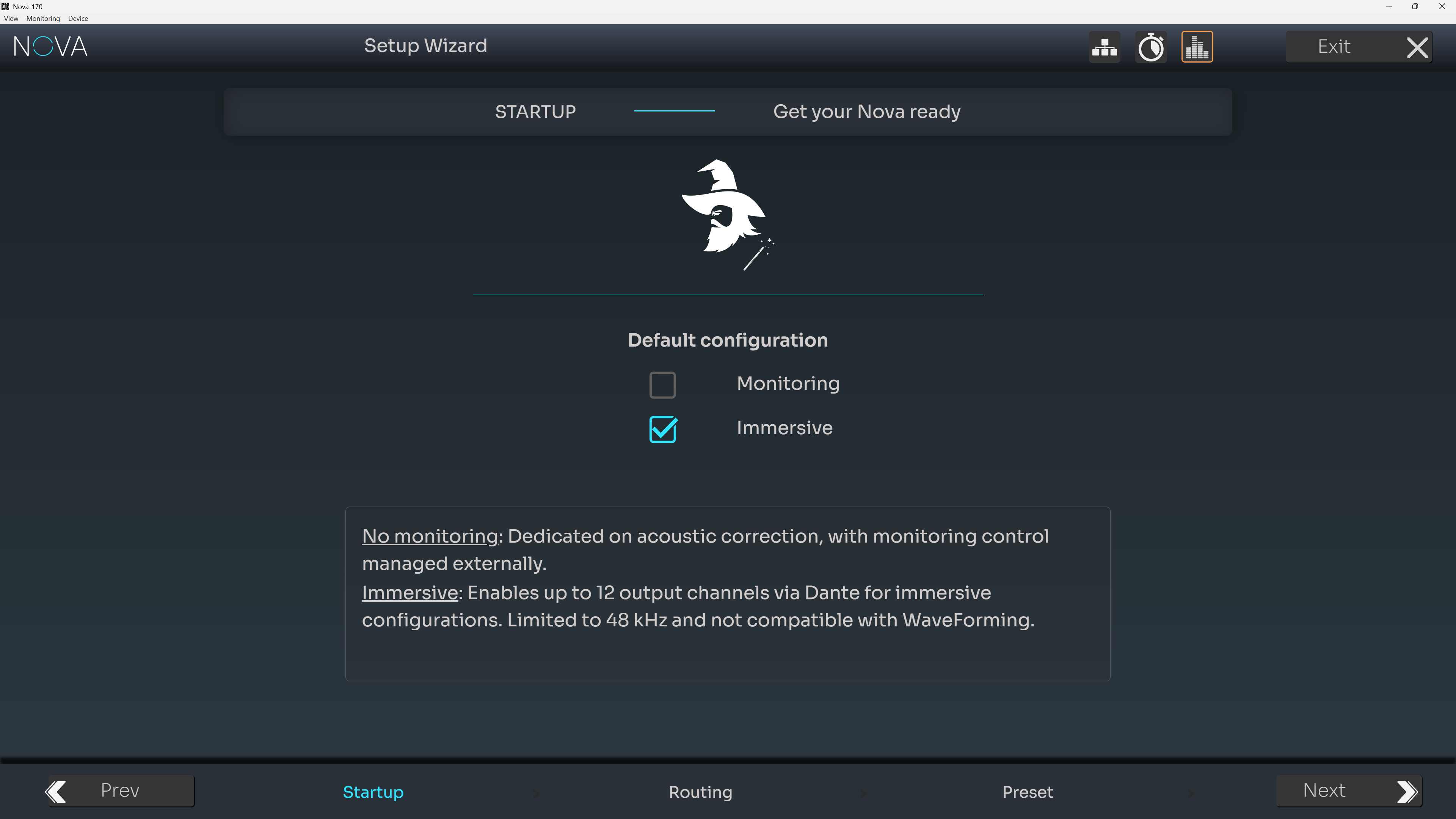
Nova New Immersive mode in the Wizard
NOVA: Compact Immersive Monitoring Without a Complicated Signal Chain
NOVA combines three functions in a single 1U platform: a monitor controller, a loudspeaker/room optimization processor, and a flexible audio endpoint.
This consolidation can simplify both the signal path and the day-to-day operation of compact production rooms.
With its immersive mode, NOVA optimizes up to 12 discrete channels in configurations up to 7.1.4 via Dante at 48 kHz. The Dolby Atmos renderer, DAW, or other production system supplies the discrete channels; NOVA does not perform the rendering itself. Instead, it sits at the monitoring stage, applying optimization to each loudspeaker channel before reproduction.
This makes NOVA particularly relevant for:
- immersive edit and premix suites;
- broadcast production rooms;
- music and podcast studios expanding from stereo into immersive audio;
- compact Dolby Atmos mixing and mastering rooms;
- quality-control and content-review environments.
Native Dante connectivity allows NOVA to fit naturally into networked facilities. It can receive the monitor feed without requiring a large analog loom and operate as an audio endpoint in rooms connected via Dante or AES67-based infrastructures. Analog, SPDIF and ADAT connectivity also make it practical to integrate with existing interfaces and legacy equipment.
NOVA is equally designed with the operator in mind. Source selection, speaker control, mute, dim, talkback-related workflows, and other monitoring functions can be accessed through the interface or Trinnov’s La Remote. EUCON compatibility also enables control from supported Avid surfaces, keeping essential monitoring commands within reach of the mixer.
For facilities growing progressively, NOVA offers a straightforward path from stereo to multichannel and immersive monitoring. A unit with eight licensed Optimizer channels unlocks up to 12 optimized outputs in immersive mode, allowing the platform to evolve without replacing the hardware.
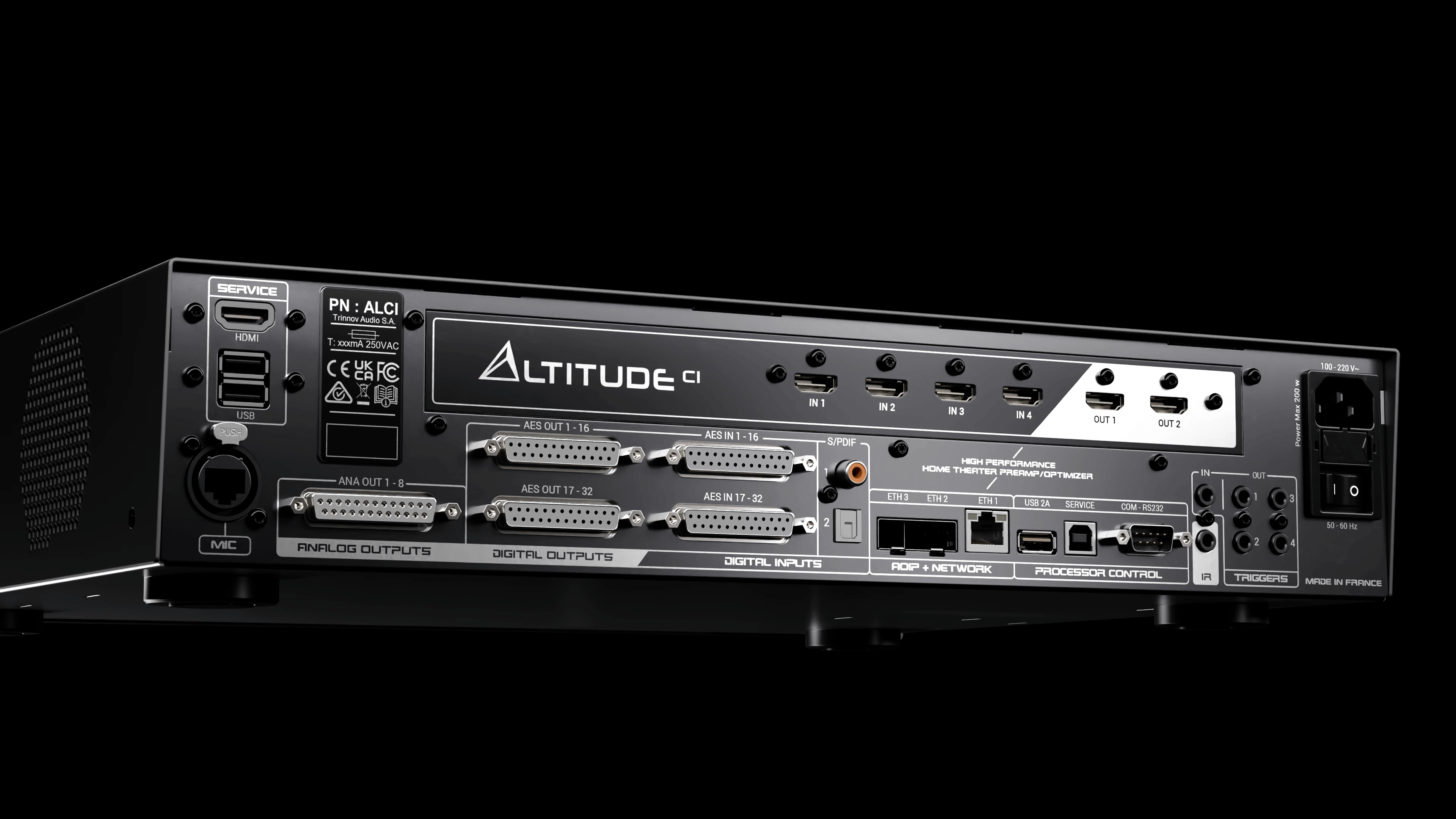
Altitude CI Extensive connectivity
Designed to Integrate into Modern Broadcast Infrastructure
For broadcast facilities, AltitudeCI goes beyond immersive processing and room optimization. Its network-centric architecture is designed for integration into professional IP-based audio environments, including SMPTE ST 2110-30 workflows, alongside native Dante and AES67 interoperability.
This allows broadcasters and post-production facilities to integrate Trinnov monitoring and acoustic optimization within their existing network infrastructure, while supporting the scalability and routing flexibility required by modern immersive production environments.
With configurations extending to high channel counts, AltitudeCI provides a bridge between Trinnov’s Optimizer technology and the increasingly IP-based architectures used throughout broadcast and post-production.
AltitudeCI: Scalable Monitoring for Larger and More Complex Rooms
Some environments require more than 7.1.4. Large dubbing stages, screening rooms, premium QC theaters, and advanced broadcast facilities may require wider layouts, additional height channels, multiple subwoofers, or specialized routing. AltitudeCI is designed for this scale.
Available in configurations from 8 to 32 outputs in two-channel increments, with build-to-order systems extending to 64 channels, AltitudeCI lets a facility specify the processing capacity required for each room while retaining a path for expansion.
Its Audio-over-IP architecture is central to that flexibility. AltitudeCI supports Dante and AES67, with network options that can accommodate integrated, isolated, or redundant paths. In a modern facility, this offers several practical advantages:
- High channel counts can travel over standard network infrastructure;
- Rooms and equipment can be separated without extensive point-to-point cabling;
- audio can be routed and reassigned as production requirements change;
- Control and AoIP traffic can be isolated for more predictable operation;
- The processor can connect to professional sources and network-enabled amplifiers or converters.
AltitudeCI also offers flexible analog, AES/EBU and AoIP output assignment, allowing facilities to combine formats rather than rebuild an entire monitoring chain around a single connection standard.
For content playback and QC applications, AltitudeCI includes native decoding for Dolby Atmos, DTS Pro, Auro-3D and IMAX Enhanced. This makes it possible to evaluate consumer-format deliverables through their actual decoding path, while its high channel capacity also supports the complex loudspeaker layouts required in larger immersive environments.
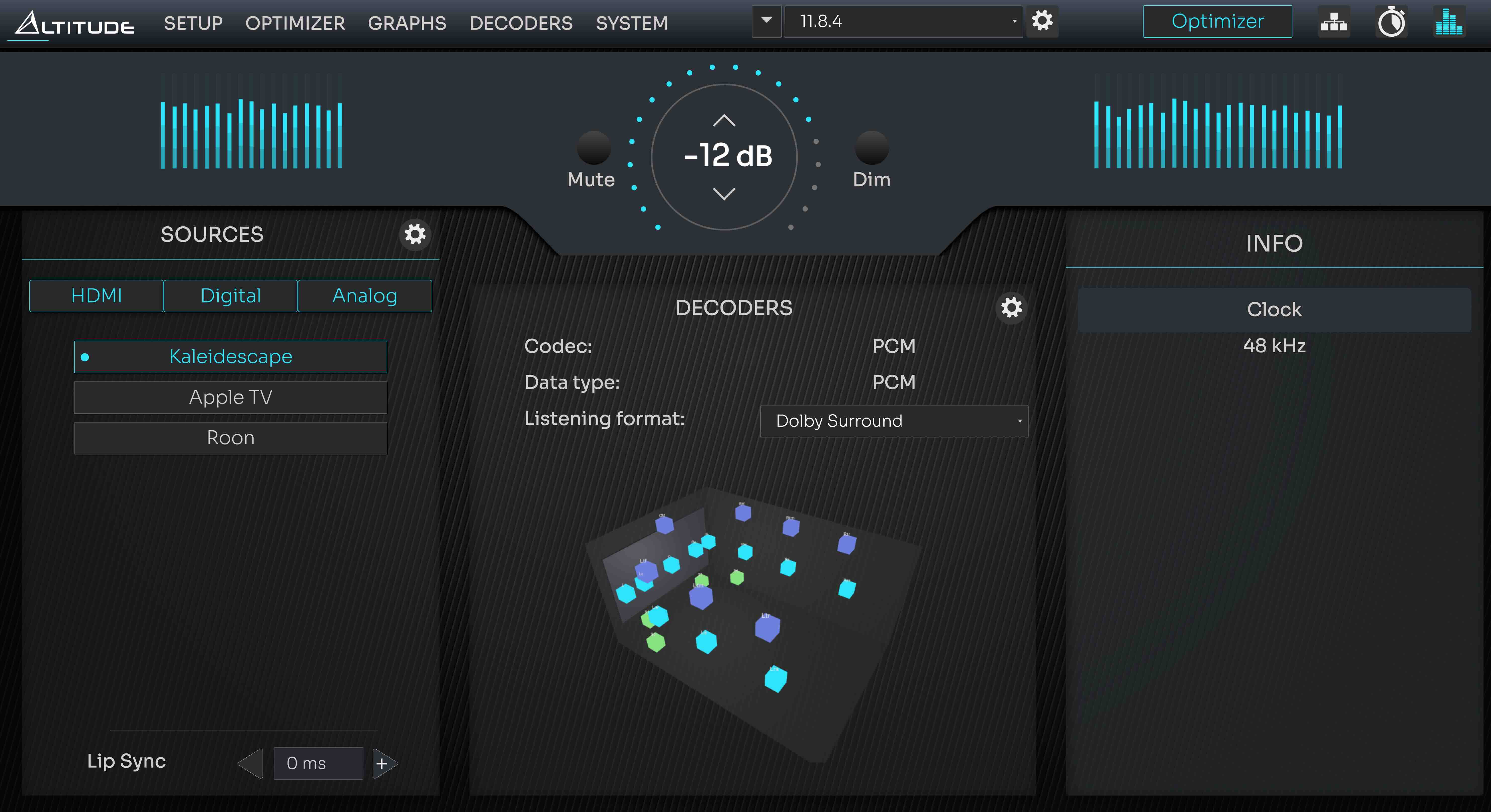
Altitude CI Home Page
Spatial Accuracy Beyond Frequency Response
Reliable immersive monitoring depends on more than a flat target curve. The relationship between each loudspeaker and the listening position determines whether pans are continuous, whether phantom images remain stable, and whether objects appear where intended.
Trinnov’s 3D measurement approach identifies the distance, azimuth, and elevation of every loudspeaker. The system can then correct level and timing differences across the array. On AltitudeCI, Remapping can go further by compensating for deviations between the intended and actual loudspeaker positions, helping preserve the spatial intent of the mix when architecture prevents ideal placement.
Low-frequency monitoring presents another challenge. Multiple subwoofers, room modes, and crossover interactions can cause bass to be inconsistent across a listening area. Both platforms provide detailed bass-management and loudspeaker integration tools, while AltitudeCI adds WaveForming for compatible multi-subwoofer designs that require more advanced control of low-frequency behavior across the room.
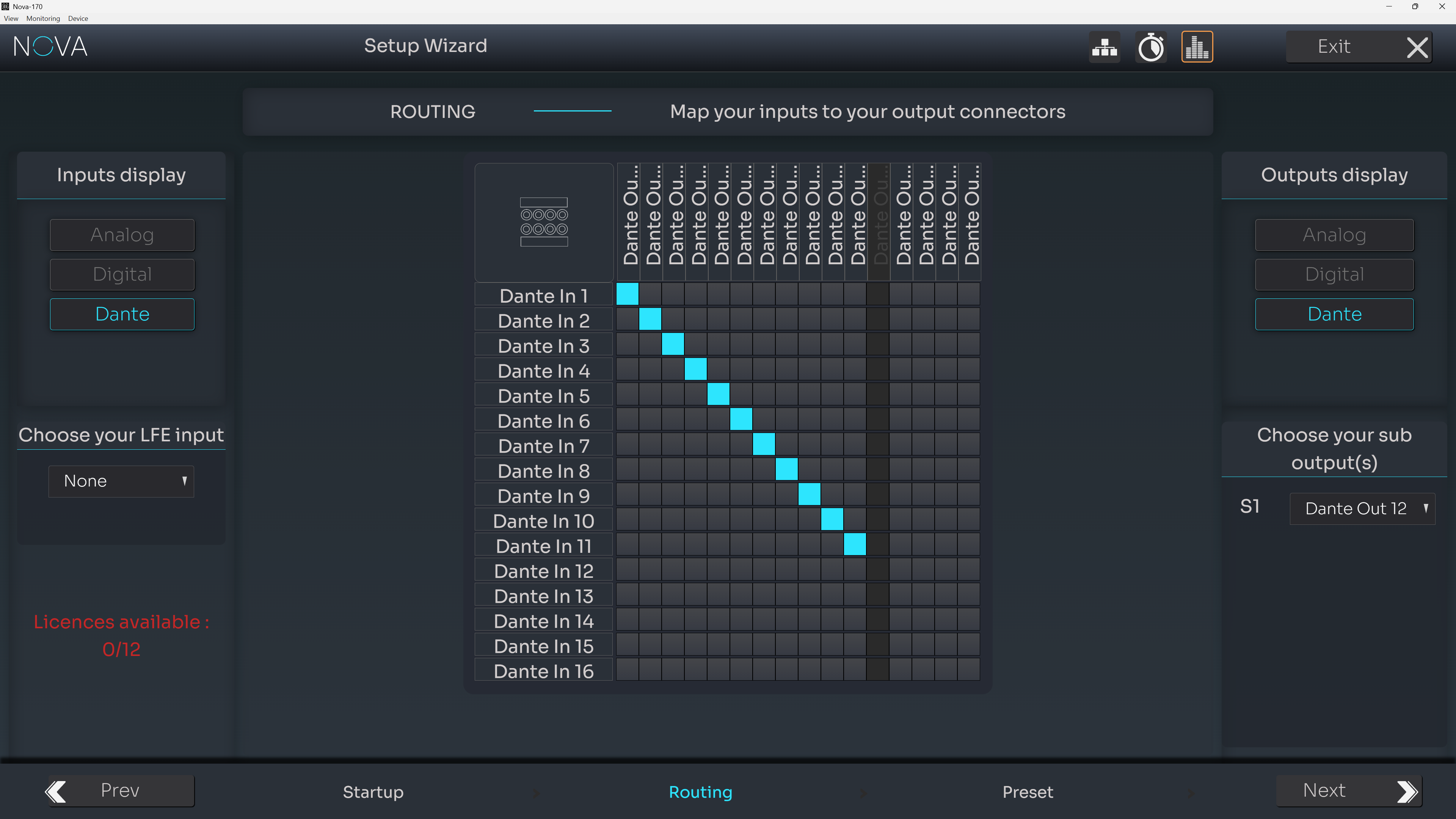
Configuration of the patchbay in Nova's Immersive Mode
Two Platforms, One Monitoring Philosophy
Nova and AltitudeCI are not simply smaller and larger versions of the same product. They address different operational needs while sharing the same goal: creating a monitoring environment that engineers can trust.
NOVA is the natural choice when a room requires streamlined monitor control, flexible connectivity, and optimization from stereo up to 7.1.4. AltitudeCI is suited to facilities that require higher channel counts, extensive network integration, advanced spatial processing, or native immersive-format decoding for playback and QC.
Used across a facility, the two platforms can also provide a coherent approach from one room to the next: NOVA in editing, premix, and compact production suites; AltitudeCI in larger mixing stages, screening rooms, and high-channel-count review environments.
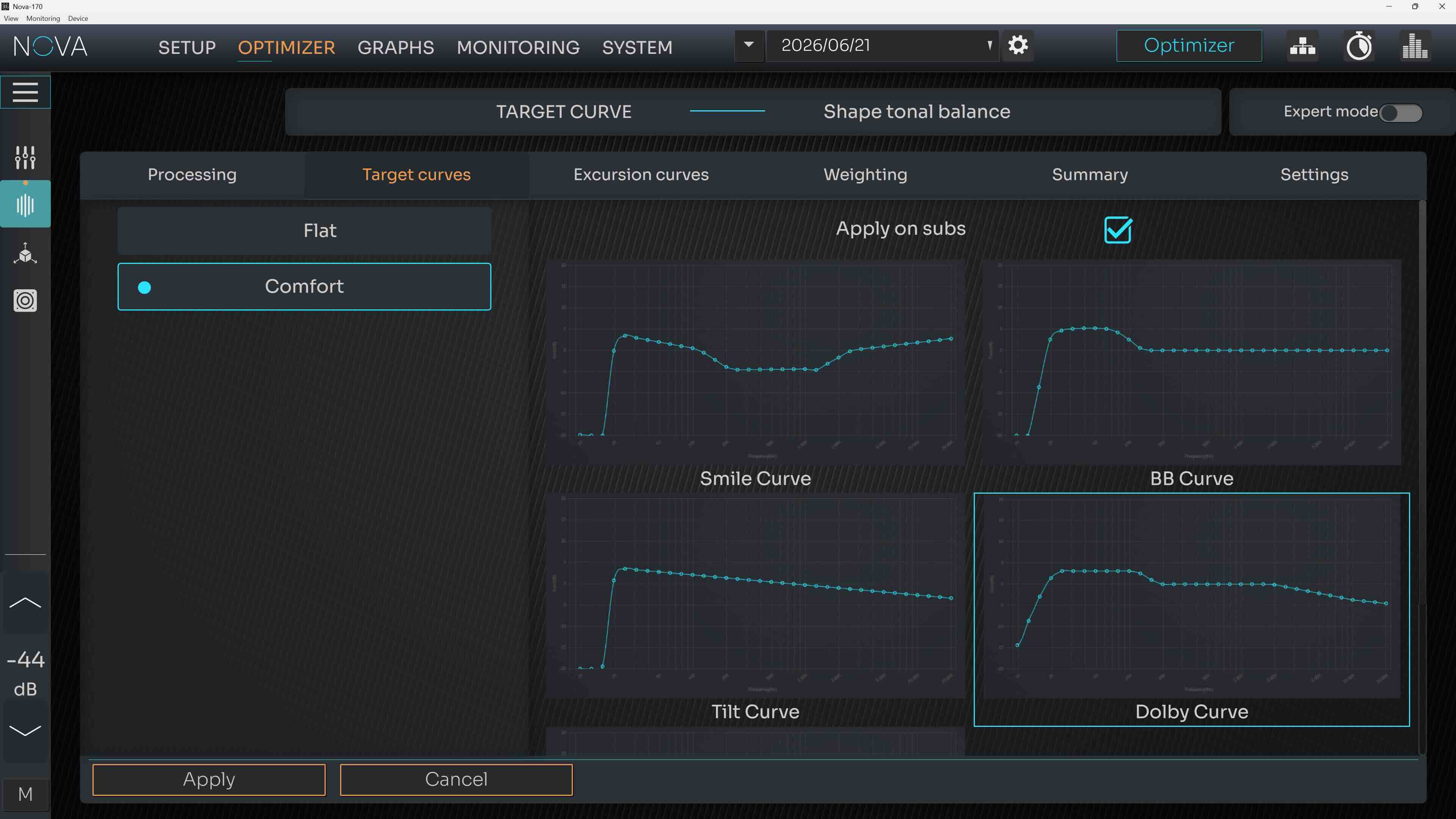
Target Curve Presets in Nova's interface
Confidence That Travels Beyond the Room
The real advantage of accurate monitoring is not the calibration itself. It is what calibration enables: clearer judgments, faster approvals, and more consistent results between rooms and mixes that translate more reliably to the audience.
As post-production and broadcast continue to move toward immersive, networked workflows, monitoring must become both more precise and more adaptable. From a compact 7.1.4 suite to a 64-channel production environment, NOVA and AltitudeCI provide a scalable foundation for making every listening decision with confidence.