

People who have never calibrated a home theater or HiFi room may assume a perfect system exists somewhere: measure the room, run the algorithm, and the process is complete with no further action needed. They may also believe that is true of any room, using any speakers, but no such system exists.
While the engineering is hard, that is not the reason. The reason is that audio preference varies from person to person, and research on listening behavior backs this up.
Studies on equalizer setting preferences have repeatedly found large, stable differences among listeners. When asked to adjust their own preferred bass, treble, or noise-reduction levels, people arrive at genuinely different settings, and their individual preferences hold up when tested again later.
This is not noise or indecision. It is a real and consistent trait of how people hear.
When one listener wants more warmth, another finds it muddy. When one wants dialogue pushed forward, another finds it unnatural.
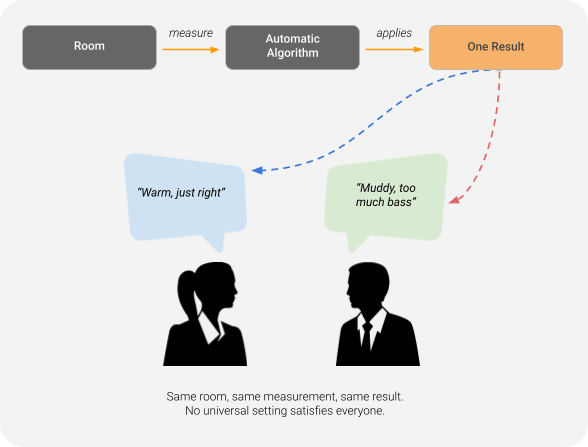
A room measurement, however precise, cannot resolve that kind of disagreement, because it was never a measurement problem. Assuming otherwise means thinking we know what someone wants to hear better than they do, and we cannot.
What audio calibration actually involves
A room measurement gives an accurate picture of what a system does acoustically. Any serious calibration starts there. Turning that picture into a result that someone will genuinely enjoy takes more. It requires someone to listen and describe what he hears, followed by someone or something adjusting the system, followed by more listening and perhaps more cycles.
That exchange has always needed a technical intermediary, because the two sides speak different languages.
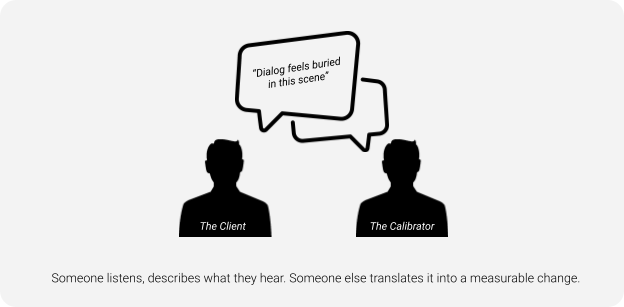
A listener describes an experience, not a setting:
- dialogue feels buried in the mix
- a particular scene sounds boomy
- the surrounds feel thin or disconnected
A calibrator translates each of those observations into a technical action: an EQ adjustment in a specific frequency range; a change to a target curve; a filter correction.
That translation, from what someone hears to what the AV processor should do, is the actual work of calibration. It explains why the field has always depended on people fluent in two languages: the language of the listener and the language of the engineer.
How AI could support audio calibration
A Large Language Model can take on part of the necessary translation. It does not need to understand acoustics the way an engineer does. What it needs is the ability to consistently map a description of an experience onto a defined set of technical actions.
Ask for more presence in the surrounds, and it identifies and applies the appropriate adjustment. Ask for tighter, less boomy bass, and it does the same.
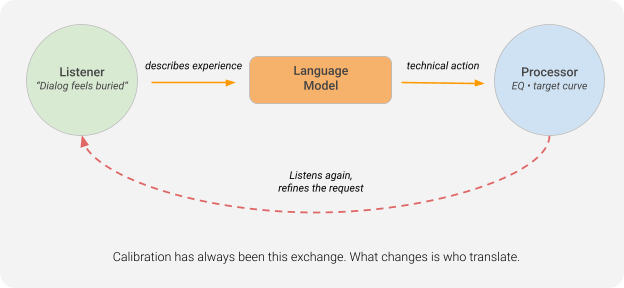
The value here is not in adding AI to a processor as a feature for its own sake. It is in enabling an exchange that calibration has always required: people who never learned the technical vocabulary can, letting them work in the language they already have: what they hear.
Why a fragmented system works against you
A model is only as precise as the tools it has available, and those tools are only as good as the platform running underneath them. This only works when the underlying system is not fragmented.
When room correction lives in one piece of software and audio processing lives in another, any action has to take place across two systems that were never built to talk to each other. Every instruction has to be translated twice, once for each system, with no reciprocal understanding between them of what the other just did.
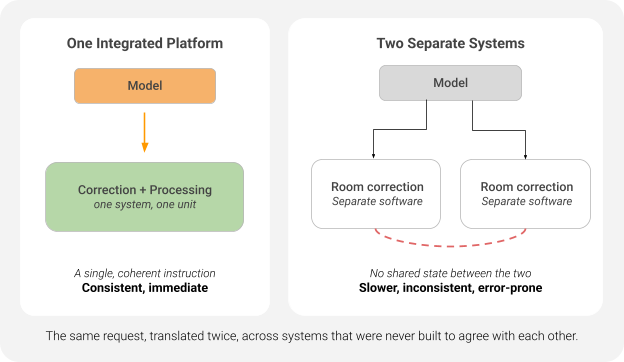
When correction, bass management, and processing live inside the same computational environment, a change made in one place is reflected immediately everywhere else, because one system computes the result. We have been building toward that kind of integration for years, well before AI made it a more viable advantage.
Why calibration still needs an expert
Great sound has never come from a machine automatically. It starts with a conversation.
A genuinely skilled calibrator will not be replaced by a model translating listening impressions into filter adjustments. That calibrator brings real depth of experience in electroacoustics, room acoustics, psychoacoustics, and, more importantly, years of accumulated judgment.
That expertise is too broad and too dependent on experience for a language model working through a defined toolset to reproduce, and we do not see that changing soon.
What can change is enabling more people to take part in the exchange in the first place. Engaging meaningfully with an advanced calibration system has always required technical fluency: reading a measurement graph; understanding a target curve; manipulating filters directly.
If a model can reliably turn a well-described listening impression into the correct technical action, the requirements shift from filter literacy to critical listening. That empowers integrators with a strong ear and good instincts who were never trained as acoustic engineers.
More people calibrating with more confidence will lead to more systems, in more rooms, sounding the way the people living with them actually want.
What's next for Trinnov at CEDIA Expo
This is a direction we are developing, not a finished product we are announcing. There is real engineering work ahead, and we intend to give it the time it needs rather than rush it.
We will share more with our dealer network at CEDIA, in a session dedicated to Trinnov partners. Anyone selling or installing Altitude systems will find the fuller picture there.