

What if we told you WaveForming works with just 2 subwoofers?
9 September 2026
Product News
| Technical Articles
Since its introduction in 2023, we have maintained a strict doctrine: a WaveForming implementation required a minimum of four subwoofers.
This was not arbitrary. It reflected our commitment to predictable, repeatable results and our reputation for giving installers performance guidelines they could trust.
We said four subwoofers, and we meant four subwoofers.
Over the past several months, however, our research team has been testing configurations we had previously ruled out. This is, in part, what we meant when we said WaveForming would keep improving.
What they found led us to revise that position.And to introduce something we did not expect to be ready this soon.
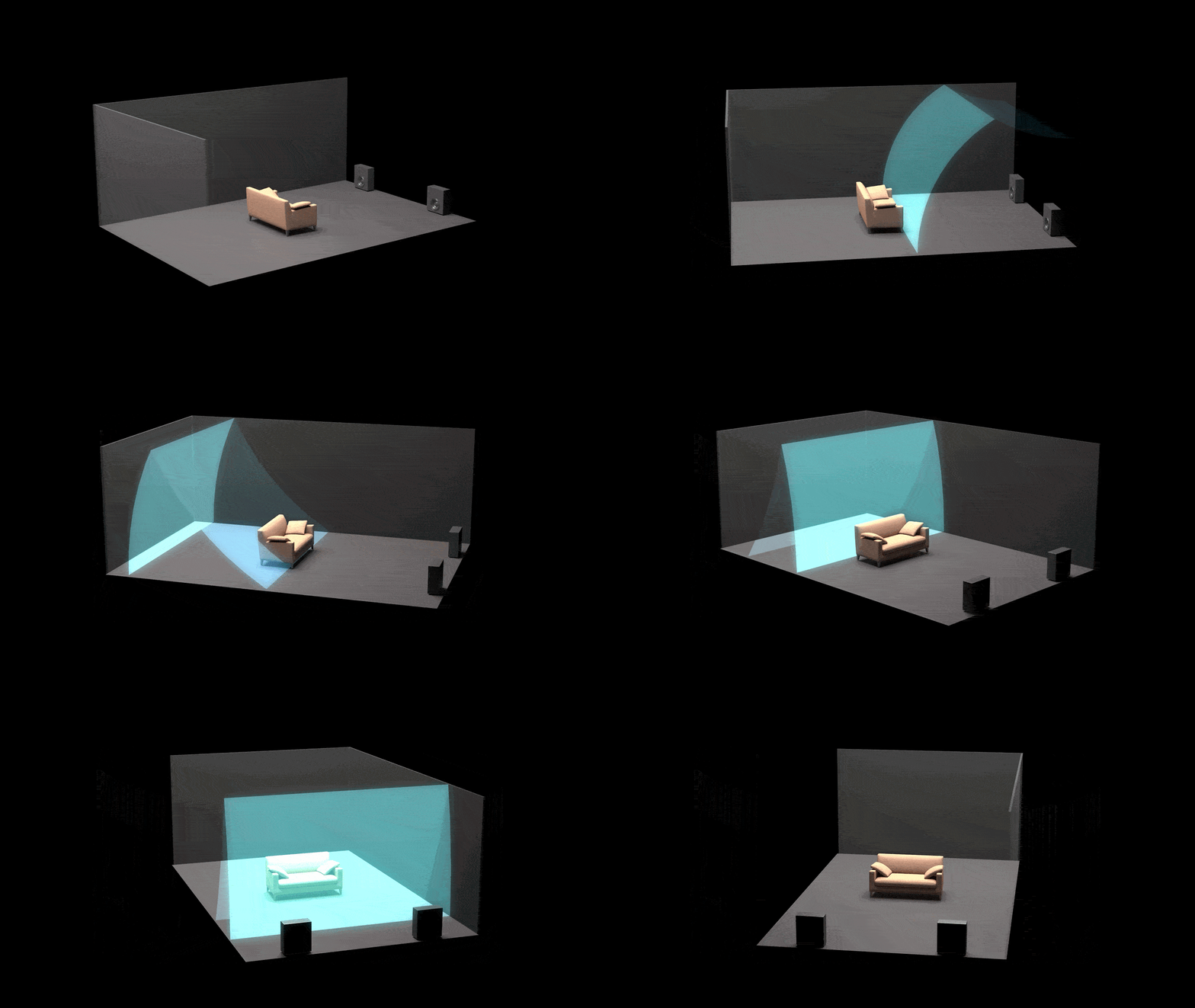
WaveForming using only Two Subs in action
How WaveForming works
WaveForming is based on active acoustics.
Rather than treating subwoofers simply as sources of bass, it uses them as acoustic tools to shape the entire low-frequency sound field within the room.
Through precise phase and amplitude management across multiple drivers, every active subwoofer contributes to both the generation of the wavefront and the absorption of unwanted acoustic energy.
This simultaneous emitter-and-absorber behavior is a fundamental principle of WaveForming and a key differentiator from more conventional approaches to bass management.
Until now, the minimum recommended configuration consisted of two front and two rear subwoofers, positioned according to our published guidelines.
The front subwoofers generate the wavefront while also absorbing reflections returning from the back of the room. The rear subwoofers intercept those reflections earlier and help extend consistent performance across a larger listening area.
Adding more subwoofers, or moving toward planar arrays at multiple heights, increases the degree of control even further.
The discovery
The question our research team wanted to answer was not whether front subwoofers could absorb acoustic energy. They always could.
The real question was whether their absorption alone, without dedicated rear subwoofers to manage back-wall reflections, could deliver results that meaningfully belonged in the WaveForming family.
Our conservative position was that they could not. The measurements said otherwise.
Two correctly positioned front subwoofers proved capable of managing enough of the room’s low-frequency field to deliver up to a 50% reduction in decay time below 100 Hz.
The result was measured across multiple rooms, with different subwoofer models and across a range of listening configurations.
The improvements were consistent enough to define a new WaveForming performance tier.
A second finding reinforced this conclusion.
Multiple subwoofers driven by a single Altitude output channel also proved to be substantially more effective as absorbers than our previous models had predicted, reducing the channel-count barrier for some installations.
In short, we had been more conservative than the physics required.
WaveForming with two front subwoofers
A two-subwoofer, front-only configuration can now qualify as a WaveForming installation when the subwoofers are positioned according to Trinnov’s guidelines.
Through active acoustics processing, those two subwoofers operate simultaneously as wavefront emitters and active absorbers.
What does that mean in practice?
- Up to 50% reduction in decay time below 100 Hz
- Substantially smoother frequency response through systematic modal control
- Meaningful improvement for one or two seats, or a compact listening area
- A straightforward upgrade path by adding rear subwoofers and recalibrating later
This makes the configuration especially relevant for focused listening environments such as recording studios, dedicated two-channel rooms and home theaters with one or two rows of seating.
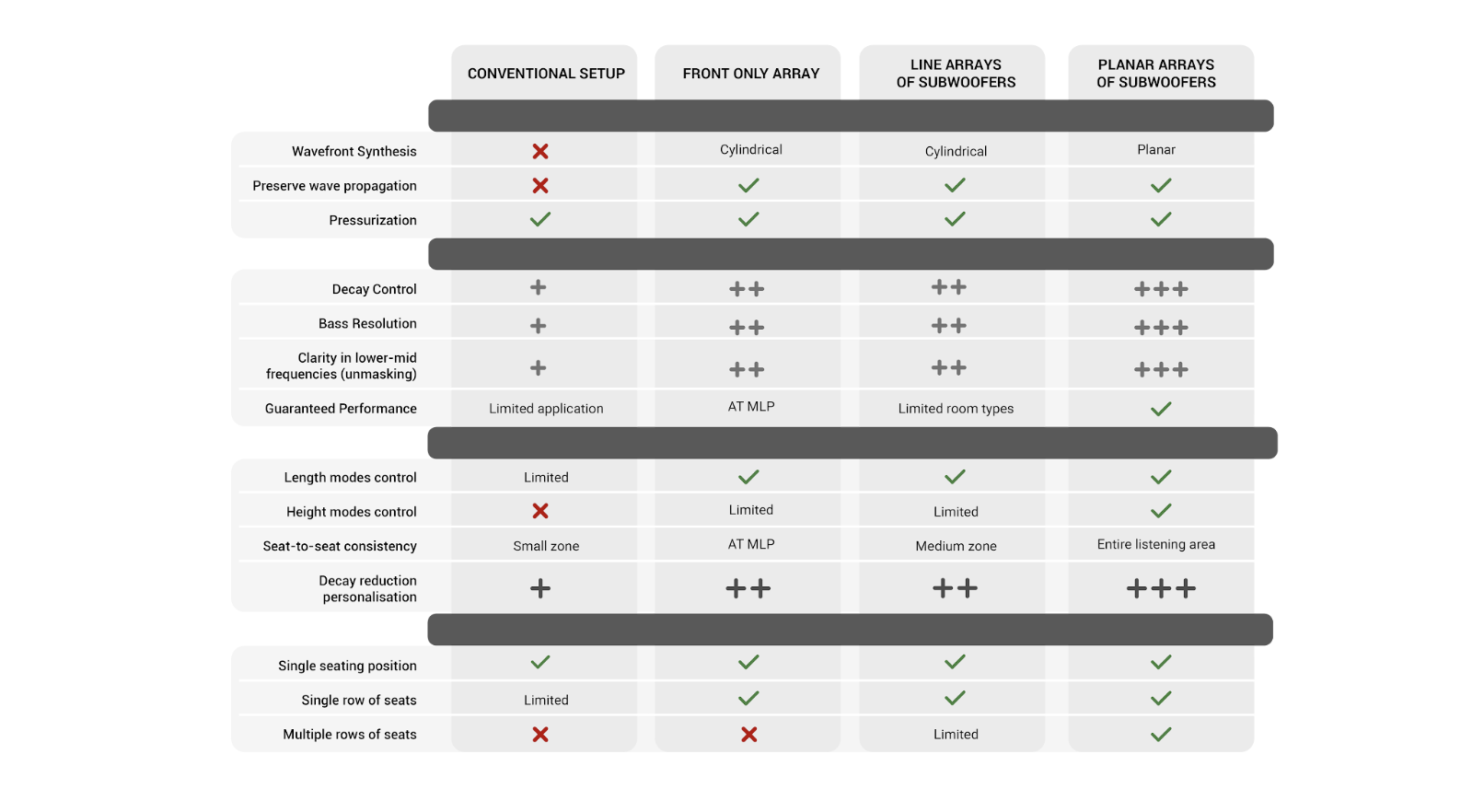
WaveForming different Flavors
What two-subwoofer WaveForming does not replace
The new configuration does not make larger WaveForming systems obsolete.
Quite the opposite.
Dedicated rear subwoofers still provide two major advantages: greater control over back-wall reflections and more consistent bass across a wider listening area.
With two front subwoofers, performance remains strongest around the optimized listening position and decreases as you move farther outside that zone.
Larger WaveForming configurations also achieve greater decay-time reduction. The management article cites typical figures of 60–70% with four-subwoofer systems, compared with up to 50% for the front-only configuration.
The different WaveForming configurations should therefore be considered cumulative performance tiers, not competing solutions.
For focused listening environments, two front subwoofers can now provide a meaningful entry point. For larger rooms and extended seating areas, configurations with dedicated rear absorption remain the recommended approach.
Why this is different from a Single Bass Array
A two-front-subwoofer configuration naturally invites comparison with a Single Bass Array.
An SBA can improve frequency-response consistency by reducing the excitation of certain room modes. However, effective low-frequency absorption generally requires substantial passive treatment on the rear wall.
Without that absorption, decay times remain long. WaveForming takes a different approach.
Both subwoofers are controlled simultaneously, with each contributing to wavefront generation and active absorption. This allows the same two-subwoofer physical footprint to achieve up to a 50% reduction in decay time.
The distinction is fundamental: WaveForming is not simply optimizing the placement or response of two bass sources. It is actively controlling the low-frequency sound field.
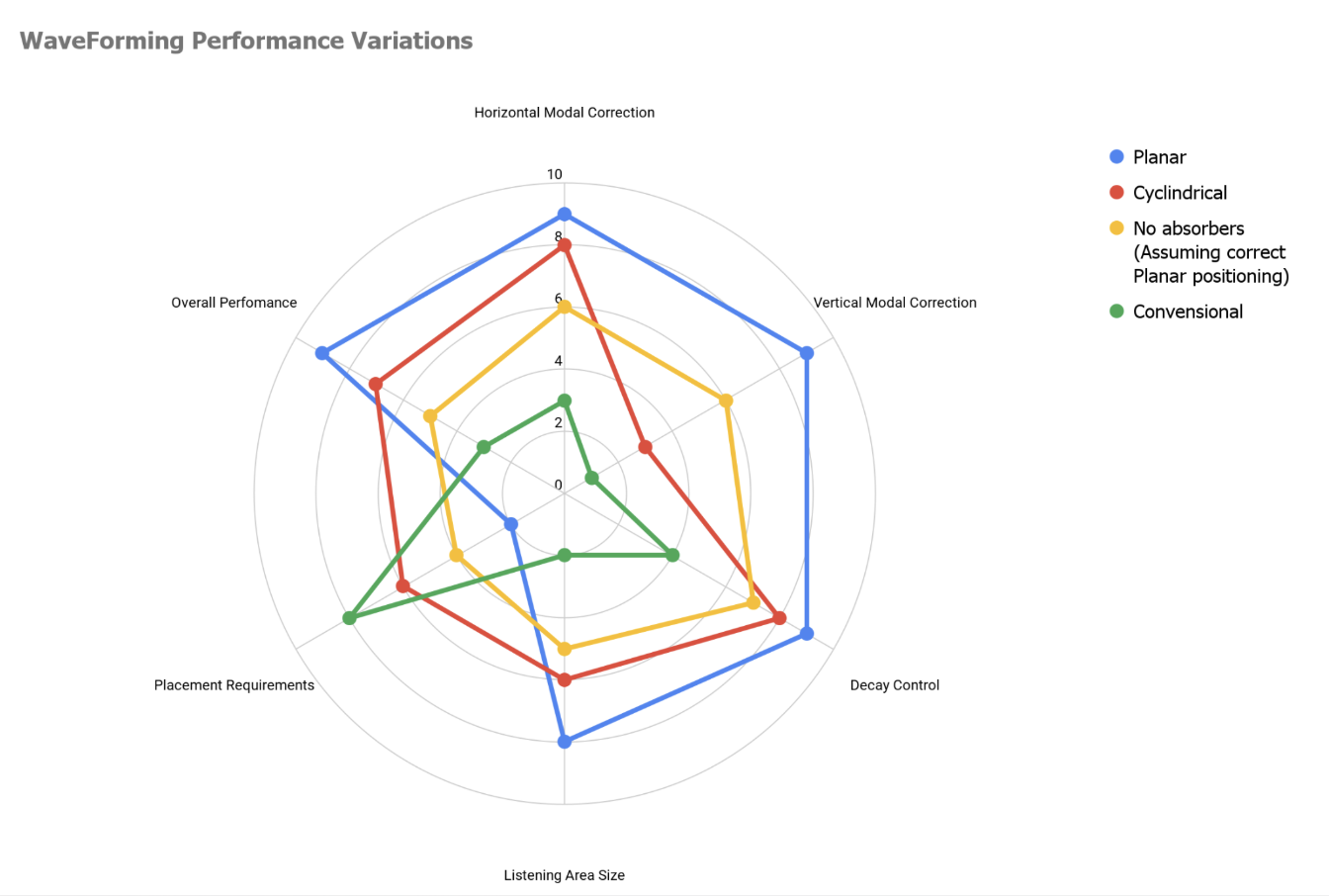
WaveForming Performance Variations
Improvements for every WaveForming system
The introduction of the new two-subwoofer configuration is only part of this software release. The core WaveForming algorithms have also been improved for all existing installations.
The WaveForming filters have been refined to improve coherence between subwoofers and satellite speakers, producing more natural bass integration across the system.
The core algorithm has also been updated to deliver more consistent and predictable behavior across a broader range of room conditions and challenging acoustic environments.
Existing WaveForming users do not need to recalibrate their systems. A simple Compute is sufficient to apply the improvements to an existing preset.
A new entry point into WaveForming
WaveForming was originally introduced with a deliberately conservative set of design requirements. Those requirements gave installers a clear and predictable framework for implementation.
The technology has continued to evolve since then, and continued research has now shown that meaningful active low-frequency control is possible with a substantially simpler system than we originally expected.
Two front subwoofers do not deliver everything a larger WaveForming array can achieve.
But for the right room and the right listening area, they can now deliver enough of the core benefits to genuinely belong within the WaveForming family.
And that opens WaveForming to a much wider range of systems.
Availability
The new WaveForming configuration and the latest algorithm improvements are available through software updates for Altitude16, Altitude32 and AltitudeCI.