

Since the official release of WaveForming in 2024, one recurring question from our users and partners has been: What SPL level will I have in my room once WaveForming technology is applied? Or, in a more practical form: How many subwoofers will I need to achieve a given SPL level in my room?
To address these questions, our research team has investigated the problem in depth and derived a theoretical expression that provides a lower-bound estimate of the SPL level generated by a regular subwoofer array in WaveForming operation.
Their research is released as a White Paper, available below.
The problem
Bass is the part of home theater design where even careful planning can fall short. Predicting low-frequency SPL in a room is one of the hardest problems in audio engineering, and honestly, it's one the industry has learned to live with rather than solve.
Below the Schroeder frequency (aka transition frequency), bass behavior depends on room dimensions, wall materials, subwoofer positions, driver characteristics, and the complex interactions of room modes. Because there are so many variables, most system designers rely on experience, rules of thumb, and a fair amount of hope. There's a reason the old adage of "whatever you think you need, double it" still gets a laugh at trade shows.
But it points to something real. Surprises on site are expensive, and systems that underperform expectations damage the trust that dealers work hard to build with their clients. The gap between what was designed on paper and what is measured in the finished room can be wide, particularly in the bass frequencies.
WaveForming: a systemic approach
WaveForming was built to address bass reproduction at the system level. Rather than treating individual room modes after the fact, it uses arrays of subwoofers on the front and rear walls to:
- Generate a controlled planar wavefront through the listening space
- Absorb energy at the back of the room to prevent reflections
- Replace chaotic standing wave patterns with a coherent, directional field
From the beginning, a central promise of WaveForming has been predictability and repeatability. If the wavefront is controlled and room mode excitation is minimized, the acoustic behavior becomes far more consistent and far less dependent on seat position.
With our latest research, we are pushing this even further.
A formula for minimum SPL
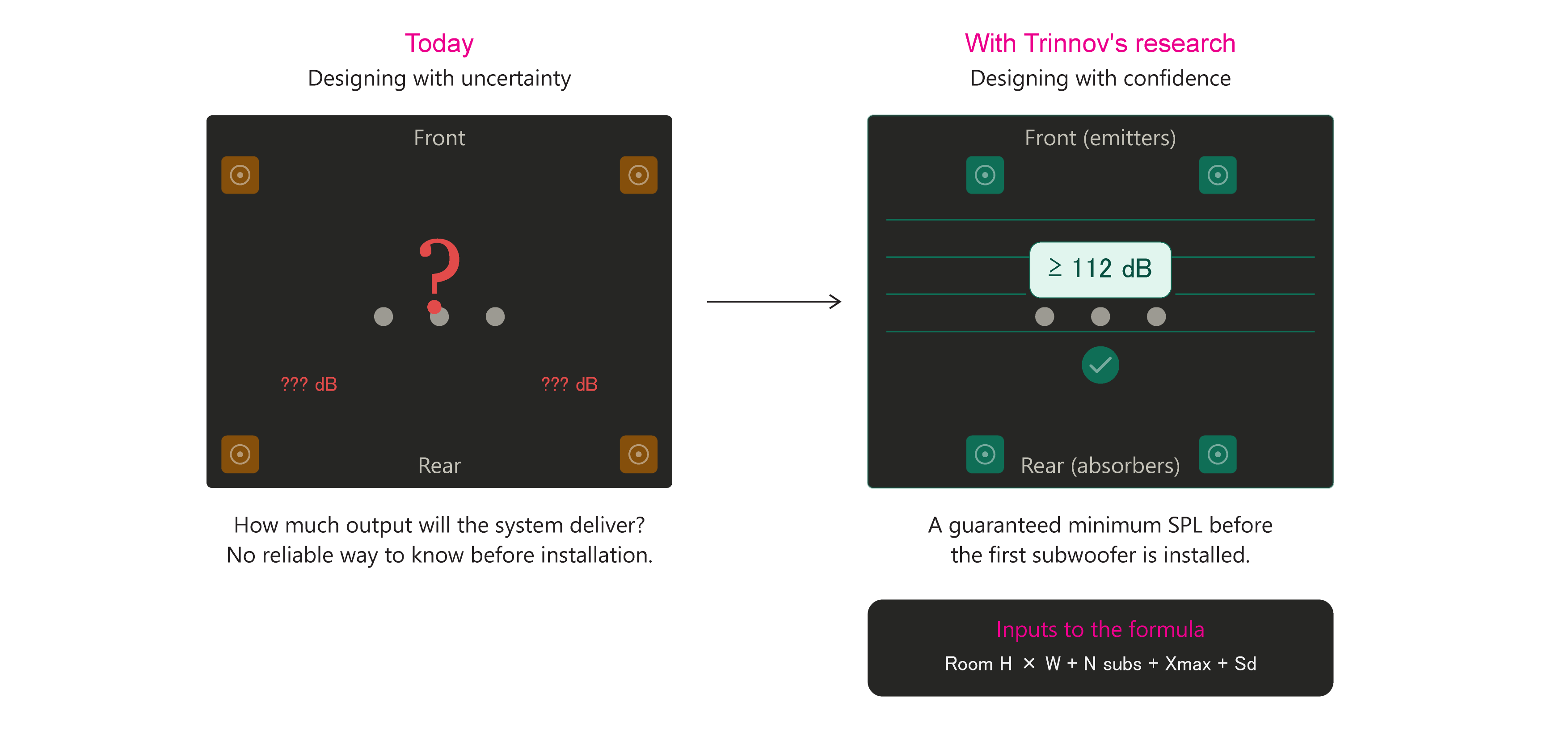
We are publishing a white paper in which our engineering team has derived a formula that calculates the minimum SPL achievable in a room when WaveForming is applied. The inputs are:
- The room's cross-section (height and width)
- The number of front subwoofers
- Each driver's peak flow rate (derived from Xmax and Sd, two standard driver parameters)
The formula provides a lower boundary, not an exact prediction. That distinction matters because it assumes ideal WaveForming conditions: a planar wavefront from the emitter array and full absorption at the rear. When those conditions are not perfectly met (irregular placement, incomplete absorption), the actual SPL will be equal to or higher than what the formula predicts.
In practical terms, the formula will tell integrators the minimum output they will get from a given set of subwoofers in a given room. If the number meets the project's requirements, the system will deliver.
A word about subwoofer specifications
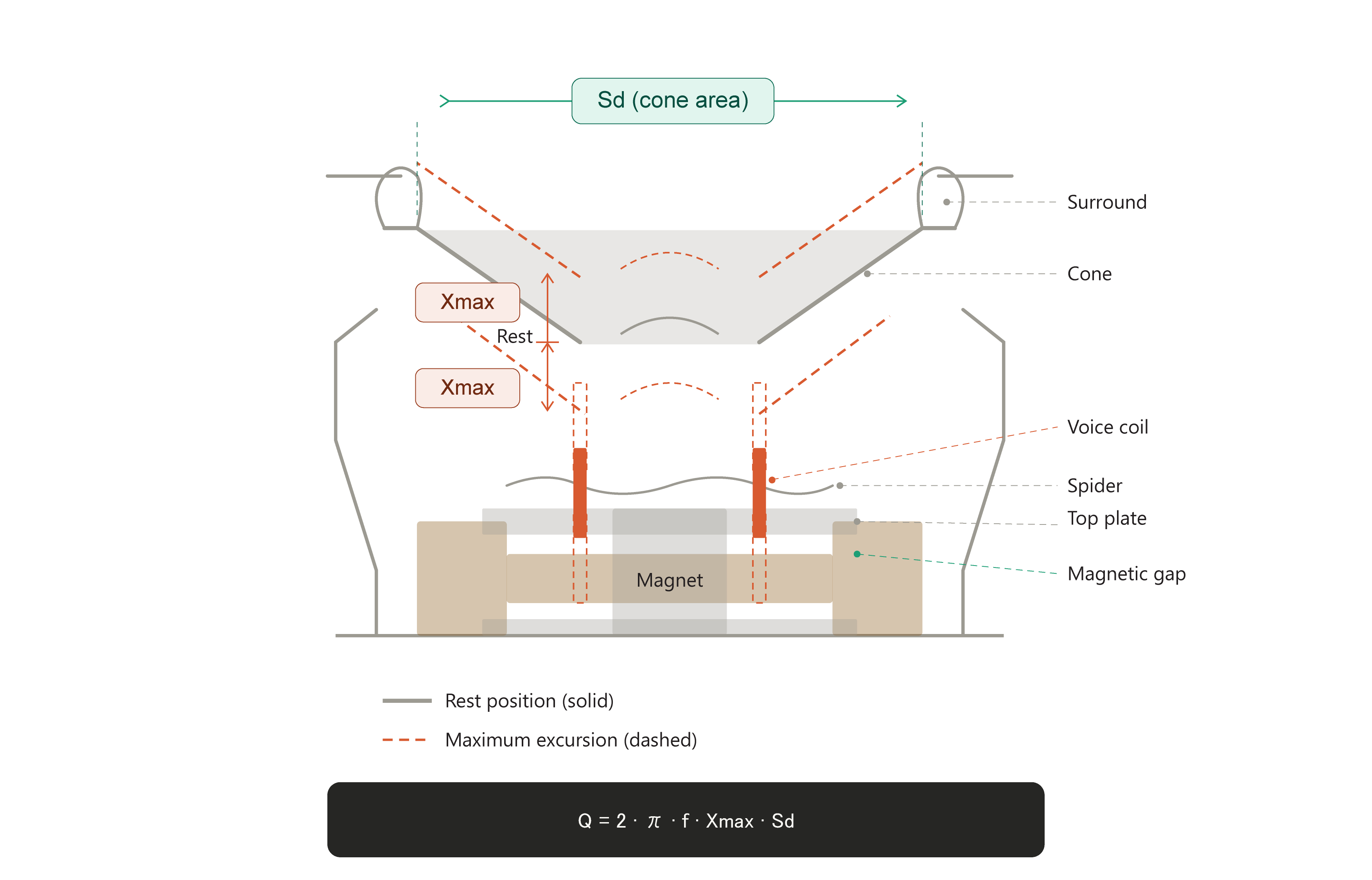
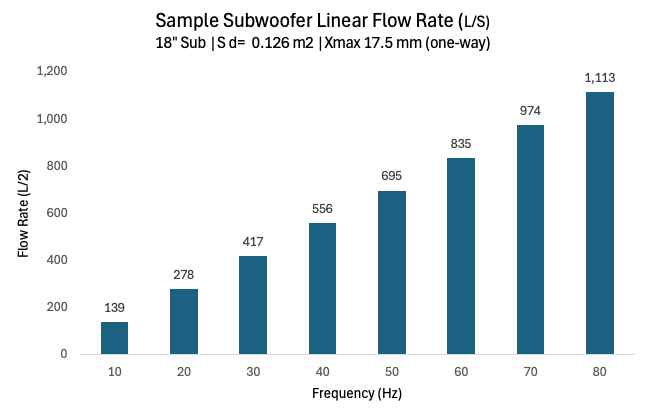
The formula above determines a subwoofer’s peak flow rate, which is the value our formula works with. To determine peak flow rate, you need two driver parameters: Xmax (maximum linear excursion) and Sd (effective cone area). Ultimately, the laws of physics dictate that a larger cone that moves further displaces more air and produces more output. Simple enough.
Xmax and Sd are fundamental Thiele/Small parameters. Every subwoofer manufacturer measures them during development, but not every manufacturer publishes them.
Xmax has become more common on spec sheets over the past few years, especially from performance-oriented brands. Sd is harder to find on finished product pages, even though it is just as important. Peak flow rate itself is, as far as we know, not published by anyone today.
If you are an integrator or an enthusiast who wants to take advantage of this kind of predictive approach, we would encourage you to look for subwoofer brands that make these specifications available. Ask for them. The manufacturers who share this data are making it easier for you to design with confidence, and that matters.
From research to practice
The white paper is a scientific publication. At this stage, it is not a plug-and-play design tool. We are working with partners to integrate this predictive capability into professional design tools available to our network of dealers and integrators. The goal is to make subwoofer specification part of a confident, data-driven design workflow rather than a hypothesis or afterthought.
A broader commitment
This research sits alongside other important industry efforts. CEDIA's RP22 standard has raised the bar on what qualifies as a properly designed home theater, and our work on SPL prediction complements that direction. With reliable output estimates before installation begins, integrators can design to those benchmarks with real confidence.
WaveForming has always been about replacing guesswork with physics. This white paper is another step in that direction.